T1D Increases the Risk of Dementia
Milena Jancev, Björn Eliasson, Hertzel C. Gerstein, Katarina Eeg-Olofsson, Tali Cukierman-Yaffe, Geert Jan Biessels, J. Hans DeVries, Frank L.J. Visseren, Naveed Sattar and Thomas T. van Sloten
Dementia Risk in People With Type 1 Diabetes and Associated Risk Factors: A Nationwide, Register-Based Cohort Study. Diabetes Care. 2025 Nov 1;48(11):1888-1895.
As people with type 1 diabetes (T1D) live longer, they face increasing exposure to age-related conditions — including dementia. While earlier studies have suggested a link between T1D and higher dementia risk, evidence on specific dementia subtypes and modifiable risk factors has remained incomplete. This large nationwide cohort study, conducted by researchers from Amsterdam UMC/Diabeter Centrum Amsterdam, University Medical Center Utrecht, Amsterdam UMC, Sahlgrenska University Hospital, and institutions across Europe and Canada, provides the most comprehensive analysis to date of dementia risk and its determinants in people with T1D.
Data from 43,440 individuals with T1D from the Swedish National Diabetes Register were compared with 217,109 age-, sex-, and county-matched control individuals from the Swedish Total Population Register. Cox regression was used to estimate the association between T1D and risk of all-cause dementia and three dementia subtypes: Alzheimer disease, vascular dementia, and non-Alzheimer–nonvascular dementia. Risk factors for dementia within the T1D population were also examined. Median follow-up was 14.3 years. Missing data were handled using multiple imputation.
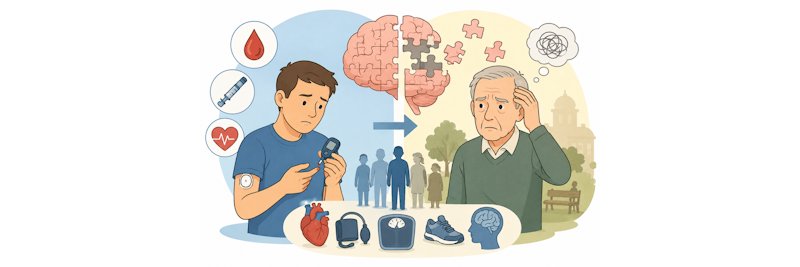 KEY FINDINGS
- Type 1 diabetes is associated with a twofold higher risk of all-cause dementia: Compared to matched controls, individuals with T1D had a hazard ratio of 2.02 (95% CI 1.83–2.23) for all-cause dementia. Dementia was diagnosed nearly five years earlier in people with T1D (median age 71.1 vs. 75.9 years).
- The risk is elevated across all dementia subtypes: The highest relative risk was observed for vascular dementia (HR 3.73), followed by non-Alzheimer–nonvascular dementia (HR 1.87) and Alzheimer disease (HR 1.38).
- Younger individuals with T1D face the greatest relative risk: The relative risk of dementia was highest in those aged 45 years or younger at baseline (HR 3.42), and decreased with age — though risk remained elevated across all age groups.
- Higher HbA1c and blood pressure are key modifiable risk factors: Beyond age, the risk factors with the greatest apparent influence on dementia risk in T1D were higher systolic blood pressure, higher HbA1c, lower education level, and single marital status — all of which were independently associated with incident dementia.
- Cardiovascular and cerebrovascular history substantially increases risk: A history of stroke or TIA was associated with a more than 2.5-fold higher dementia risk, and a history of cardiovascular disease with a 1.5-fold higher risk, in people with T1D.
- Severe hypoglycaemia was not significantly associated with dementia risk in this cohort, though the authors note the relatively low number of severe hypoglycaemia events may have limited statistical power to detect an effect.
This study provides the clearest evidence to date that T1D substantially increases the risk of all-cause dementia and each of its major subtypes, with vascular dementia showing the strongest association. The findings point to several potentially modifiable risk factors — in particular glycaemic control and blood pressure — that may offer opportunities to reduce dementia risk in this population. As the number of older adults living with T1D continues to grow, dementia deserves greater recognition as an important long-term complication of the condition.
CONCLUDING THE AUTHORS STATE
"Our findings highlight the need for a greater recognition of the risk of dementia in type 1 diabetes."
Please click here for the full text.