Early Detection of T1D: A Roadmap for European Implementation
Sufyan Hussain, Timothy Tree, Chantal Mathieu, Tomasz Klupa, Anna-Kaisa Tuomaala, Maartje de Wit, Olga Kordonouri, Katarina Braune, Jaivir Pall, Luis Castano, Rachel E.J. Besser, Júlia Galhardo, Francesca Ulivi, Emanuele Bosi, Uroš Bogdanovic, Coralie Alabert, Tadej Battelino
An international consensus on screening and monitoring early-stage type 1 diabetes: A roadmap to European implementation. Diabetes Obes Metab. 2026;28(5):3535–3556. Epub 2026 Mar 12.
Type 1 diabetes (T1D) affects an estimated 2.8 million people across Europe, with incidence rising annually. Despite advances in treatment, a diagnosis of T1D in children is still preceded by hospitalisation for diabetic ketoacidosis (DKA) in 20–67% of cases across European countries — a potentially life-threatening event with both acute and long-term consequences. Screening for islet autoantibodies offers a concrete opportunity to change this.
This consensus document, developed by an international author group including Diabeter Center Amsterdam/Amsterdam UMC researcher Maartje de Wit, outlines the rationale, essential components, and a practical roadmap for implementing population-wide screening for early-stage T1D across Europe. Drawing on evidence from ongoing programmes such as Fr1da (Bavaria), ASK (Colorado), ELSA (UK), and D1Ce (Italy), the authors formulate recommendations across four domains: general principles, infrastructure, participation, and evaluation.
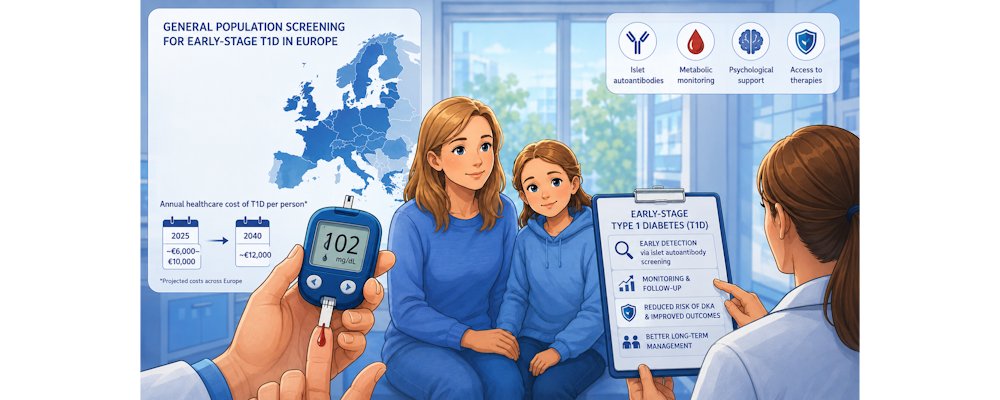 KEY FINDINGS
- DKA at diagnosis remains a major problem: Across Europe, 20–67% of children present with DKA at T1D diagnosis. DKA is associated with impaired cognitive development, poorer long-term glycaemic outcomes, and substantially higher healthcare costs.
- Early detection reduces DKA dramatically: In the Fr1da screening programme, only 3.2% of autoantibody-positive children developed DKA at progression to clinical T1D, compared to 20–35% nationally. Participation in monitoring programmes can reduce DKA incidence by up to 80%.
- Disease-modifying therapy is now available: Teplizumab has been approved by the FDA, Health Canada, MHRA, and EMA for use in Stage 2 T1D, delaying progression to clinical diabetes by a median of over two years. Population screening is essential to identify eligible individuals before symptoms develop.
- Over 85% of new T1D diagnoses have no family history: Current screening approaches focused on relatives or genetic risk groups miss the vast majority of people who will develop T1D. General population screening is necessary to reach them.
- Public awareness campaigns already make a difference: Even before formal screening begins, stakeholder engagement and awareness activities have been shown to reduce DKA admissions at T1D diagnosis — by approximately 16% in the Italian D1Ce pilot.
- Psychological support is integral: A positive screen can cause anxiety and uncertainty in individuals and families. Psychosocial support, clear communication, and education must be embedded in screening pathways from the start.
- Data infrastructure must keep pace: Dedicated registries capturing outcomes for all screened individuals — including those who test negative — are needed to benchmark performance, evaluate therapies, and drive service improvement.
The authors emphasise that the scientific and clinical case for general population islet autoantibody screening is compelling and that WHO criteria for public health screening are close to being fully met for T1D. Successful implementation requires coordinated investment across education, infrastructure, and monitoring — and must prioritise equitable access for all populations, regardless of socioeconomic status, ethnicity, or geographic location.
CONCLUDING THE AUTHORS STATE
"This is the moment for wider application of general population islet autoantibody screening and to create national and international goals for reducing the human and economic burden of T1D in Europe" -
Please click here to go to the full text pdf.