Early detection of T1D: The V1ND trial
Christine Fransman, Henk-Jan Aanstoot
Recente ontwikkelingen rond vroegdiagnose type 1-diabetes. Ned Tijdschr Diabetol 24, 24–25 (2026)
Background and Rationale
Type 1 diabetes (T1D) has a long asymptomatic phase. Months to years before the classic symptoms appear (stage 3), the disease process is already detectable through islet autoantibodies (stage 1 and 2). Screening for T1D makes early diagnosis possible, offering clear benefits: a lower risk of metabolic derangement (including diabetic ketoacidosis) at clinical onset, and better opportunities for a smoother adaptation to, regulation of, and acceptance of the disease. Disease-modifying therapies that can delay progression in these early stages are now also becoming available.
International research in both high-risk groups (such as relatives of people with T1D) and the general population has expanded considerably in recent years, and screening — often combined with celiac disease screening — is now available in a number of countries and regions. National and international guidelines, protocols and consensus statements have since been developed to guide the further set-up of screening, early diagnosis and the monitoring this requires.
A clear distinction exists between screening and early detection. Screening identifies the underlying disease process through autoantibodies. Staging then follows, based on glucose metabolism: in stage 1 only autoantibodies are present, while in stage 2 glucose values are already abnormal — tracked through a monitoring protocol. Diabetic glucose values mark the start of stage 3, though the exact definition of this transition is still under discussion. Alongside the oral glucose tolerance test (OGTT), continuous glucose monitoring (CGM) is becoming an increasingly important tool in this process.
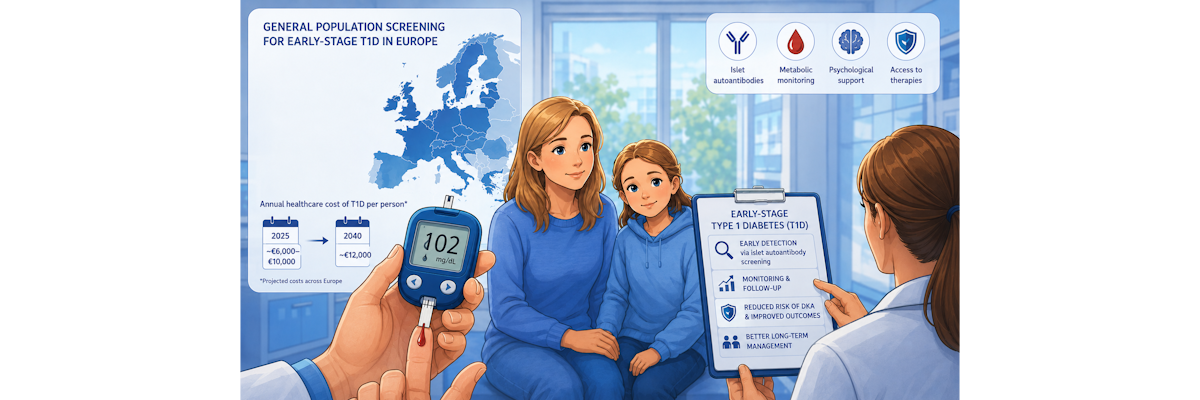 Early detection carries not only diagnostic but also clinical significance, requiring follow-up care to be organized differently — with attention to monitoring, guidance and care coordination. Psychosocial factors play an important role alongside the clinical ones: early detection calls for specific guidance, education and clear communication. The period between identifying an early stage (stage 1 or 2) and the onset of clinical symptoms (stage 3) can bring uncertainty and stress, which requires careful, well-coordinated support. It remains insufficiently clear which form of guidance is most effective and how it can best be organized — a question this project aims to help answer.
Study Objectives
The V1ND project investigates screening, confirmation, monitoring and psychosocial support for early-stage T1D in an integrated way, within a Dutch research setting. It aims to generate insight into the feasibility and integration of early detection within Dutch clinical practice, and to contribute to the international evidence base.
Much of the current knowledge on screening and early detection comes from studies in children and adolescents; knowledge and experience in adults remain limited. Screening also raises important ethical questions — the Dutch Council for Public Health and Society (Raad voor Volksgezondheid & Samenleving) has cautioned against overly optimistic assumptions about screening and early diagnosis. V1ND aims to contribute to a future in which T1D can be detected early, opening the way to treatment that delays — and potentially defers — clinical onset.
Study Design & Study Population
V1ND starts this autumn (2026) as a research project combining:
- Screening for islet autoantibodies
- Confirmation and staging (glucose metabolism, OGTT/CGM)
- Structured monitoring of early-stage (pre-stage 3) T1D
- Psychosocial guidance and support throughout the process
Inquiries about this study can be sent to c.fransman@diabeter.nl or hjaanstoot@mac.com
Click here for the fulltext article (in Dutch)